

A beginner-friendly guide to understanding artificial intelligence concepts and terminology
What is Artificial Intelligence?
AI is all about making machines that ‘think’ for themselves. It is a branch of computer science. This field can handle and perform tasks that usually need human intelligence. At its core, AI processes large amounts of data, using mathematics and trained models to recognize patterns and make predictions. Simply put, AI is like a super-smart prediction machine.
Types of Artificial Intelligence
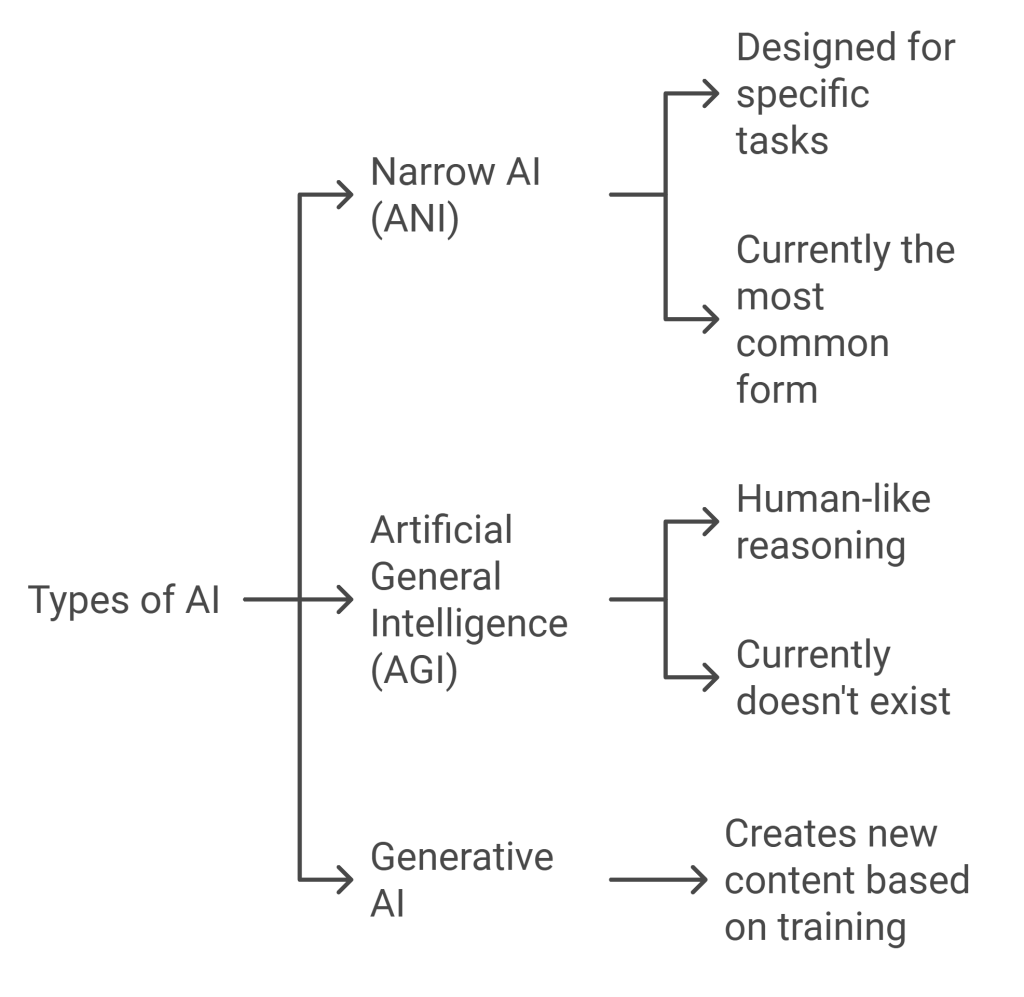
Narrow AI (ANI)
Narrow AI or Weak AI, is designed for a specific task, like image creation language generation, and much more. Because narrow AI is so good at these areas, it often outperforms humans. But it doesn’t have human intelligence, flexibility, or adaptability yet. Almost all the AI we see today is Narrow AI.
Artificial General Intelligence (AGI)
AGI refers to machines that think, reason and understand human emotions on par with human intelligence. It would not only match our intelligence but potentially surpass it in many areas. When people talk about an ‘AI Apocalypse,’ they’re often imagining AGI. Currently, AGI is still an idea and doesn’t exist. AI experts think that it is likely years (even decades!)away from being achieved.
Generative AI
Generative AI, has the name suggests ‘generates’ new content based on patterns from large datasets , it’s been trained on .
Traditional AI focuses on problem-solving and decision-making and acts within a set of rules or algorithms. Generative AI doesn’t just follow rules—it generates something new based on patterns it has learned from data.
Example :- ChatGPT, is a generative AI that can generate text based on user prompts.
Machine Learning
Machine Learning is the branch of AI focused on how machines learn from data. Computers analyze large amounts of data to identify patterns and use these patterns to make predictions.
Types of Machine Learning
There are three main types of learning in Machine Learning
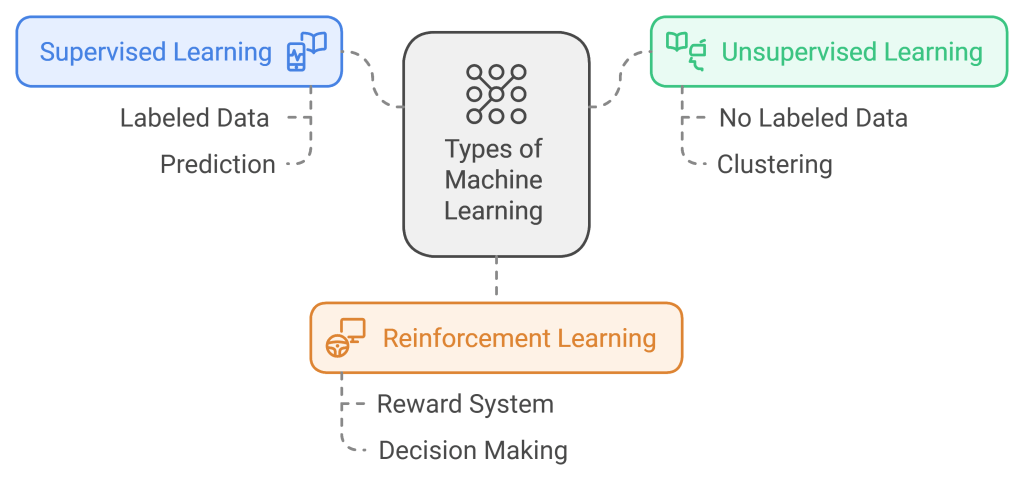
Supervised Learning
The model learns from labeled data, which includes an input and the correct output. The model learns to connect the input to the correct output and uses this training to make predictions on new data.
Example: Identifying spam emails, where emails are labeled as ‘spam’ or ‘not spam.’
Unsupervised Learning
In this type, the model works with unlabeled data, and tries to find patterns or groupings within the data on its own. After it generates results, human feedback is used to refine its performance.
Example: Grouping customers based on spending habits to identify different customer segments.
Reinforcement Learning
In this type of learning, the agent learns by interacting with its environment. The agent learns though trial and error method. When its action is the correct , it gets a reward (positive feedback), and gets a penalty (negative feedback) when it gets its actions wrong. The goal of this system is to maximize the cumulative reward over time.
Example: Game playing AI, Robotics control
Deep Learning
Deep Learning is a specialized subset of machine learning that uses neural networks with many layers (hence the term ‘deep’). These deep networks are especially effective at finding complex patterns in large datasets, making it ideal for tasks like image recognition, natural language processing and to be used In Large Language Models(LLMs).
AI Models and Architectures
AI Models
Models are the blueprint of AI systems. They are programs containing information on how data should be processed. They usually contain mathematical representations to find patterns and make predictions with minimal human intervention. There are many models, and they are used under different conditions. We have heard the most famous one, the Large Language Model.
Neural Networks
Neural networks are type of machine learning model inspired by the human brain’s structure. The basic units of a neural network are artificial neurons (also called nodes), which are organized in layers. A neural network has an input layer (which receives data), hidden layers (which process the data), and an output layer (which produces the result). Each neuron in the hidden layer takes input, processes it, and sends output to the next layer.
Want to know how it human brain and artificial neuron networks compare with each other? Read on..
Large Language Models (LLMs)
LLM’s are models trained to understand and generate human language. They are trained using massive amounts of data to learn patterns in languages. They power all the AI chats, virtual assistants, and other tools that interact with humans using language. They are built using Transformer Architecture.
Transformer Architecture
Architectures refers to the way the components in the models are arranged , It’s architecture enables parallel processing and grasp contextual meaning better through a feature called attention mechanism. LLMs typically use the transformer architecture.
Diffusion Models
While LLMs are used for language tasks, diffusion models are for image generation, specifically in text-to-image applications. These models learn from large datasets of text-image combinations to understand both language and visuals. During training, the model distorts an image into static noise and learns to reverse this process, reconstructing the image based on its training data. This step-by-step transformation from noise to a clear image gives it the name ‘diffusion model’. Examples: DALL-E and Stable Diffusion.
Multimodality
Multimodality refers to AI systems that have the ability to understand and generate content across various data types, like text, images, audio, and video.
Technical Component
Tokens
When a prompt is entered, the AI breaks it down into smaller units called tokens. Tokens can be words, sub-words, or even individual characters. For example, the sentence ‘I love dogs’ could be split into tokens in different ways:
- Word tokens: (‘I’, ‘love’, ‘dogs’)
- Sub-word tokens: (‘I’, ‘lo’, ‘ve’, ‘do’, ‘gs’)
- Character tokens: (‘I’, ‘l’, ‘o’, ‘v’, ‘e’, ‘d’, ‘o’, ‘g’, ‘s’)
When using API keys for AI systems for external applications or automation, charges are based on the number of tokens processed for input and output.
Practical Concepts
Prompt Engineering
Since AI models respond to the input data given to them, how a question is phrased matters. The way the question or request is structured (called a ‘prompt’) directly influences the model’s response. A clear, specific, well-structured prompt with context leads to more precise output. The response will also be accurate and relevant. Prompt engineering is the process of crafting well-designed prompts to get the best possible results from an AI model.
Best practices:
- Prompts should be specific and clear
- Give proper context
- Use examples when needed
- Break down complex requests
AI Limitations and Challenges
Hallucinations
When AI models generate an answer, it isn’t always guaranteed to be correct. Sometimes, the AI can produce information that sounds precise but is made up or incorrect.
Causes
- Pattern overextension: The AI model outputs something based on patterns it was trained on to situations where those patterns don’t apply.
- Training data gaps: When AI comes across situations or queries that are outside the purview of its training data, Instead of acknowledging the lack of knowledge, the model might give information that is not factually accurate or fill the gaps with fictional details.
- Confidence in incorrect correlations: AI models can form inaccurate correlations or develop false patterns between unrelated concepts when in training mode.

Bias
AI models can sometimes produce biased results if they are trained on data that doesn’t represent everyone fairly. This can lead to skewed or unfair outcomes for certain groups of people. AI bias is something researchers actively work to reduce, aiming to make AI systems more fair and accurate.
Infrastructure and Computing
GPUs (Graphics Processing Units)
GPUs are like super-brains that process tons of data really fast. It is still is used in the world of Video games. GPUs can parallel process really fast, unlike the traditional CPUs(Central Processing Units)
NVIDIA is a leader in the AI chip market. The company achieved this mainly through its advanced GPU technologies. These technologies are designed for deep learning and artificial intelligence applications.
For more insights into artificial intelligence and technology, subscribe to our monthly newsletter covering the latest developments in AI research and applications.



 The Ai Ship
Leave a comment