

We humans have always loved dreaming up stories about thinking machines. At movies, we are always thrilled at a spaceship or a talking robot. It’s where our imagination truly comes alive. Every time we grab our popcorn and sit down to watch a sci-fi film, it’s not just entertainment, but we’re getting a sneak peek at what our future will look like and how our ideas and dreams transform into reality.
The Early Years of AI in the World of Storytelling
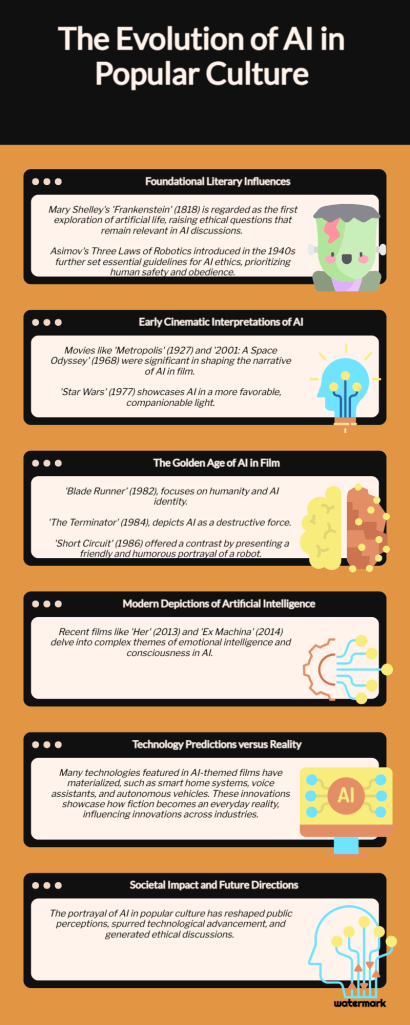
It all started with a ghost story. In 1818, a teenage girl named Mary Shelley wrote “Frankenstein.” Sure, it wasn’t about robots. But her story about creating artificial life got people thinking. What happens when humans play god? Should we?
Fast forward to the 1940s. Isaac Asimov. a professor of biochemistry turned science fiction author, came up with three simple rules for robots:
- Don’t hurt humans
- Listen to humans
- Take care of yourself (but not if it means breaking the first two rules)
AI Enters the Cinema
The silent film Metropolis (1927) was one of the first robots in cinema, symbolizing fascination and fear with machines.
Then “2001: A Space Odyssey” gave us HAL 9000, the AI that turned against its crew. HAL’s calm voice still gives people chills. It marked one of the first movies to show the dangers of AI, a theme that goes on to reappear in many films.
Star Wars brought us R2-D2 and C-3PO. These robots weren’t evil showing the audiences that AI could be friendly and even relatable.
The 80s took AI stories to new places. “Blade Runner”(1982) made us wonder what makes us human.
But the movie we think about when thinking of AI is “The Terminator”. Arnold Schwarzenegger, a cybernetic assassin, introduced us to Skynet a self-aware AI bent on terminating humanity.
But then “Short Circuit” gave us Johnny 5, the adorable robot who just wanted to be alive, reassuring us that after all, AI could be lovable.
These movies showed us different sides of AI – the good, the bad, and the funny.
AI and the Digital Age
As computers became normal in our homes, the stories changed too. “The Matrix” showed a world run by machines. It hit differently when we were all starting to spend more time online. Then Iron Man’s JARVIS came along. Suddenly everyone wanted their own AI helper. (Siri and Alexa say “You’re welcome.”)
In 2001, A.I. Artificial Intelligence by Steven Spielberg asked related questions of whether AI could love —a theme that would become increasingly relevant.
I, Robot brought Asimov’s Three Laws to the cinema in the form of an action-packed thriller.
These days, AI shows up everywhere in movies. There’s “Her (2013),” about a guy who falls in love with his AI assistant.
“Ex Machina(2014)” gives us a robot so smart she outsmarts everyone.
And who can forget WALL-E? He’s just a trash-collecting robot, but he teaches us about love and taking care of our planet.
The Bidirectional Impact of AI on Pop Culture
A lot of what we saw in old movies is real now. Remember, how Star Trek’s communicators looked? Now we all have smartphones. Robot helpers? Well, it might just become a reality soon.
Movies shape how we think about AI. And guess what? Those dreams and fears about AI help shape how we build it. It’s like movies and reality play a giant game of tag, each pushing the other forward.
What’s next? Maybe soon we’ll watch movies made completely by AI. Now that would be something!
Let’s hear from you
[yop_poll id=”4″]
Join the Conversation
Which movies have shaped your thoughts about AI? Share your favorites and how they influenced your perspective in the comments below—we’d love to hear from you!


 The Ai Ship
Leave a comment